TMS for OCD: A New Hope When Traditional Treatments Fall Short
You’ve tried the medication. You’ve done the therapy, followed every recommendation your provider gave you, and you still wake up each morning bracing for the intrusive thoughts, the rituals, the exhausting loop that OCD creates in your mind. You’re not failing at treatment. You may simply need a different kind of treatment altogether.
Obsessive-compulsive disorder affects millions of adults, and while first-line approaches help many people, a significant portion of those living with OCD find that their symptoms don’t fully respond to standard care. For those patients, transcranial magnetic stimulation (TMS) — a non-invasive brain stimulation therapy — has emerged as a meaningful next step. TMS for OCD is now FDA-cleared, clinically supported, and available as part of a comprehensive psychiatric treatment plan.
Understanding what TMS actually does, who it’s designed to help, and what the research shows can make a real difference when you’re trying to figure out where to go from here.
When Standard OCD Treatments Stop Working
Most people with OCD begin with two well-established approaches: medication and a specific form of therapy. Both have solid track records, and for many patients, they provide meaningful relief. But for others, they only go so far.
The Limits of Medication
Selective serotonin reuptake inhibitors (SSRIs), the antidepressants most commonly prescribed for OCD, are considered the gold standard in pharmacological treatment. The challenge is that up to 40 to 60 percent of OCD patients don’t achieve adequate relief from these medications, even after trying multiple options at therapeutic doses. Some people experience partial improvement but still struggle with symptoms that interfere with daily life. Others face side effects that make staying on medication difficult. When the medication stops being effective or isn’t effective enough, it doesn’t mean treatment is over. It means a different approach is needed.
Why Therapy Alone Isn’t Always Enough
Exposure and response prevention (ERP), a type of cognitive-behavioral therapy, is considered the most effective form of psychotherapy for OCD. It works by gradually exposing patients to their fears and helping them resist compulsive responses. ERP is genuinely powerful, but it’s also demanding, and not every patient responds fully. Some people experience significant anxiety during the process, which makes it hard to engage. Others hit a plateau where the remaining symptoms feel stuck, unresponsive to further behavioral work. When therapy and medication together aren’t enough, patients deserve to know what else exists.

What Is TMS and How Does It Work for OCD?
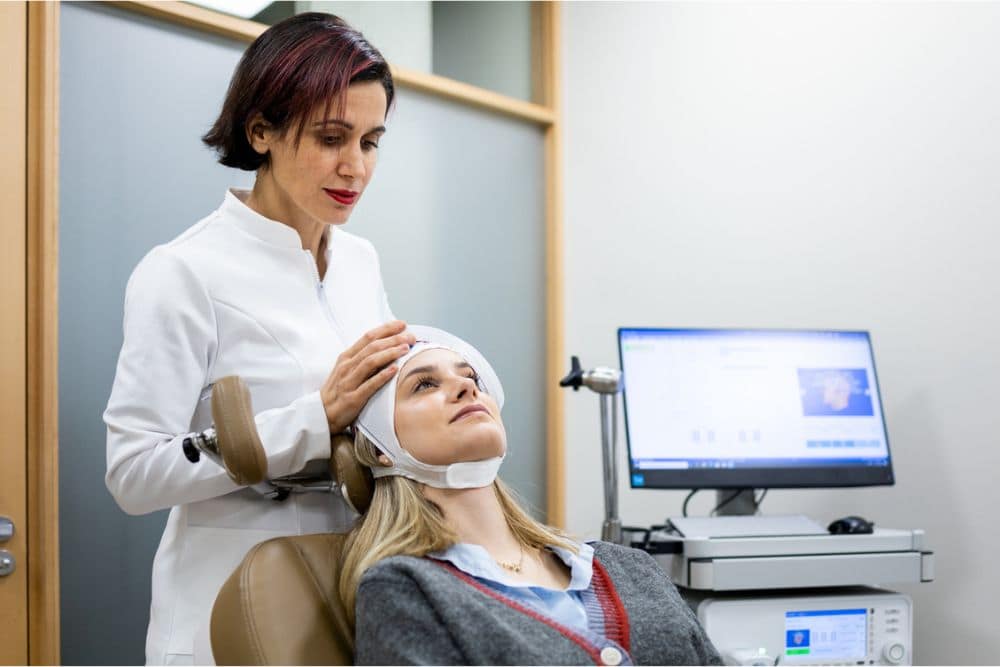
TMS therapy uses focused magnetic pulses to stimulate specific areas of the brain without surgery, anesthesia, or medication. The same basic principle that powers an MRI machine is directed in short, precise bursts to targeted brain regions, influencing neuronal activity in ways that can produce lasting therapeutic change. It’s outpatient, well-tolerated, and requires no recovery time.
Targeting the Brain Circuits Behind OCD
OCD isn’t simply a thought problem. It’s a circuit problem. Research consistently points to dysregulation in the neural pathways connecting the prefrontal cortex and deeper brain structures involved in habit and fear processing. In people with OCD, these circuits appear to get stuck in a loop, generating the intrusive thoughts and compulsive urges that define the disorder. TMS for OCD is designed to intervene at that level, delivering magnetic stimulation to the dorsomedial prefrontal cortex and anterior cingulate cortex, the brain regions most implicated in OCD symptoms. By modulating activity in these areas, TMS works to interrupt the circuit dysfunction rather than simply managing symptoms from the outside.
What a TMS Session Actually Looks Like
Sessions are conducted in a clinical setting and typically last about 18 to 20 minutes. You remain fully awake and alert throughout. A magnetic coil is positioned against your scalp, and you’ll feel a repetitive tapping sensation as the pulses are delivered. Most people find it manageable, and any initial discomfort usually fades within the first few sessions. The standard FDA-cleared protocol for OCD involves 29 sessions over approximately six weeks, five days a week. Importantly, a brief symptom provocation component is included before each session, in which a therapist briefly prompts awareness of OCD-related thoughts. This is intentional and is thought to enhance the effectiveness of the stimulation by activating the relevant circuits right before treatment begins.
What the Research Says About TMS for OCD
TMS for OCD isn’t experimental. It’s backed by clinical trial data and has received formal FDA clearance, which means it has met the agency’s standards for safety and effectiveness.
FDA Clearance and Clinical Evidence
The FDA cleared deep TMS for OCD in 2018, making it the first non-invasive device therapy ever authorized for the condition. That clearance was based on a randomized, multi-center, sham-controlled clinical trial of 100 OCD patients. The trial measured outcomes using the Yale-Brown Obsessive Compulsive Scale, the standard metric for assessing OCD severity, and found statistically significant reductions in symptom scores among patients who received active TMS compared to those who received a non-working sham device.
Response Rates and What to Expect
In the pivotal trial, 38.1 percent of patients who received active TMS achieved a meaningful clinical response, defined as a reduction of at least 30 percent in symptom severity, compared to just 11.1 percent in the sham group. Real-world data collected across 22 clinical sites confirmed that the majority of OCD patients who undergo TMS experience meaningful benefit, with most showing initial improvement within 20 sessions. For some patients, extending the treatment course beyond the standard protocol produces continued improvement. Results vary by individual, and TMS works best as part of a comprehensive care plan that may still include medication and therapy.
Who Is a Good Candidate for TMS for OCD?
TMS is specifically designed for people whose OCD has not responded adequately to standard treatments. It’s not a first-line option, but it’s also not a last resort. It’s a meaningful middle path for patients who need something more.
Signs TMS Might Be Right for You
You may be a good candidate for TMS for OCD if you relate to several of the following:
- You have tried at least one SSRI at a therapeutic dose without adequate relief
- You have engaged in ERP therapy, but still experience significant symptoms
- Your OCD symptoms are meaningfully disrupting work, relationships, or daily functioning
- You want to avoid adding another medication or increasing your current dose
- You are looking for a treatment that works differently from anything you’ve tried before
What to Discuss with Your Provider
Not everyone is a candidate for TMS. Certain medical factors, including a history of seizures or the presence of metal implants near the head, can affect eligibility. A thorough evaluation by an experienced psychiatric provider is the right starting point. From there, your provider can help you understand whether TMS fits your history, what to expect from the process, and how it would integrate with any existing treatment you’re receiving. TMS is cleared as an adjunctive treatment, meaning it works alongside your current care rather than replacing it entirely.
Find Out If TMS for OCD Is Right for You at Mile High Psychiatry
At Mile High Psychiatry, we understand that treatment-resistant OCD is exhausting, and that the patients who need the most help are often the ones who have already tried the most options. Our team works with adults throughout Colorado who are living with OCD that hasn’t fully responded to medication or therapy, and we offer comprehensive psychiatric care that includes evaluation for TMS. Request an appointment with Mile High Psychiatry today and take a step toward treatment that works differently — because you deserve care that actually works.

